Bangladeshi fishermen detained by Arakan Army, authorities silent
Nearly 200 families await the return of their loved ones detained by the Arakan Army while fishing in the Naf River, while there is no visible action by the Bangladeshi authorities.

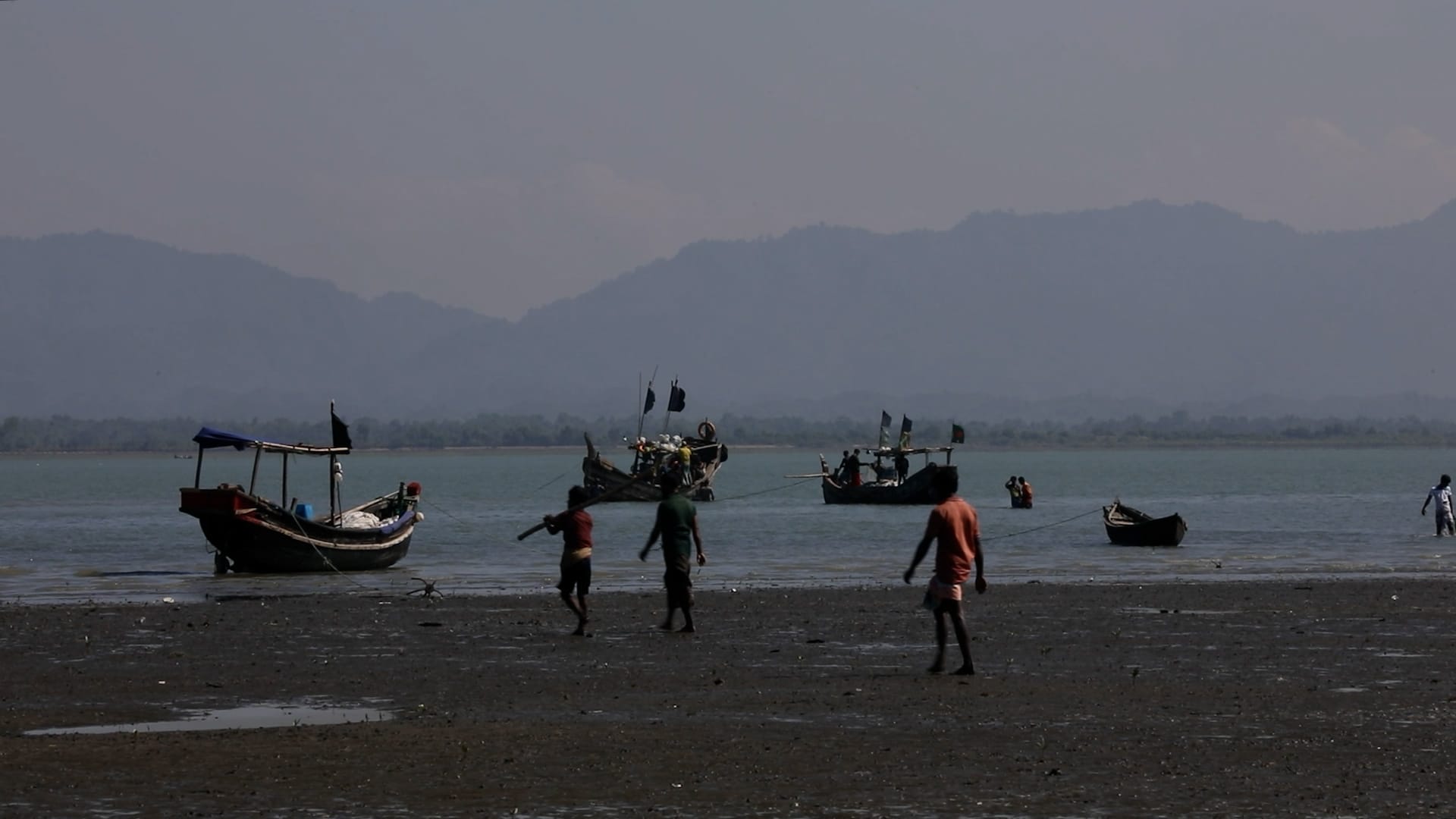
On November 11th 2025, Habiba Begum stood on the beach at Dhakshinpara, Shah Porir Dwip, Teknaf. It had been nearly three months since she last saw her husband. “I will get the groceries and pay the children's school fees when I come [back] from the sea,” the fisherman’s wife recounted as the last thing her husband told her.
On August 22nd, Habiba’s husband left in the morning for a fishing trip into the Bay of Bengal. Later on the same day, the Arakan Army (AA) seized a fishing boat carrying Habiba’s husband and 10 other fishermen from the waters east of Saint Martin’s Island. And all the men on board were detained.
“Now we are not receiving any news about them. We do not know if they are alive or not,” said Habiba, who last saw her husband in a photo published on August 26th by the Global Arakan Network (GAN), a news outlet which regularly publishes photos of Bangladeshi fishermen detained by AA.
With her family’s sole breadwinner held captive by the AA, Habiba struggles to feed her three children. She had to pull her daughters out of school, now relying on her brother’s income. Habiba is not alone. Her plight is shared by nearly 200 families across the coastal community.
From August 12th to December 3rd this year, the AA has detained 176 Bangladeshi fishermen and seized 30 boats and trawlers confirmed by the GAN, and corroborated by Bangladeshi boat owners’ association leaders. Among the detainees, some are Rohingya men who work on the boats as day labourers, according to trawler owners.
Khotija Begum, the mother of a detained the fisherman, spends her days consumed by grief. “I don’t even see him in my dreams. Allah, at least show him in a dream. My son, are you alive, or have the Mugh [Arakan Army] killed you?” she wailed.
Another mother, Rahima Khatun, stated that despite repeated appeals to local authorities, including the Border Guard Bangladesh (BGB), the District Commissioner (DC), and the Upazila Nirbahi Officer (UNO), “in two and a half months, we have received no news of whether they are dead or alive.”
This statement was echoed by family members of six detained Bangladeshi fishermen and Sultan Ahmed, a trawler owner who has been fishing in the area for half a century. “We used to travel to the Bay of Bengal from the Naf River via Myanmar maritime waters for decades. We faced no obstacles until the Arakan Army's takeover,” he added.

‘Dark like a grave’
Between January and July 2025, the AA reportedly released 188 detained Bangladeshi fishermen and 30 boats. Among them were nine fishermen captured on March 6th, along with their trawler, from the waters east of Saint Martin, and released after three months in captivity. Three of the fishermen shared graphic details of their experience with Netra News.
Mohammad Abdullah recounted how he was blindfolded, transported, and the conditions in which he was held captive. “It was dirty, mosquitoes would bite, it was intensely hot, no fan, no light, no electricity, dark like a grave.”
Meanwhile, food was meagre and barely edible. Mohammad Belal shared that they were fed dried jackfruit. “Even the rind was chopped and boiled without turmeric and salt in hot water.” He also asserted that they were detained “from Bangladesh territorial waters” while they were only “half a kilometer distance” from a Bangladesh Navy vessel.
Detainees were also subjected to forced labor, including sweeping roads, cleaning the property, and performing construction work for the AA. Mohammad Aiyub, another fisherman, reported physical abuse, “When they are intoxicated, they lose their minds. They wake us up and just beat us. They didn’t use sticks, they punched and kicked us.”
Fishing in risky border waters
The motivations behind the detentions remain unclear with fishermen’s representatives citing seizure of resources and the AA claiming security and law enforcement. Boat owner Foysal claimed the detentions are primarily motivated by the seizure of assets. “They have never seized an empty boat. They only seize the trawlers when they return to the harbor with fish from the sea,” detailing the loss of hundreds of thousands of taka in fish, nets, and equipment from his boat.
Belal echoed the same, noting that the AA distributed the seized fish to several of its outposts. He also recounted a message the AA instructed them to convey: “Ask your country to go for a treaty; allow [us] to bring food.”
Another factor forcing fishermen closer to the Myanmar maritime border is the critical siltation of the traditional navigation channel from the Naf River to the Bay of Bengal. Sajed Ahmed, president of the Teknaf Municipal Boat Owners Association, pointed out that this compels them to sail nearer to the Myanmar maritime border. "The channel we used to use for going to Saint Martin's has now silted up. Now there is no opportunity for trawlers to go [that way]. We have to use the waters on Myanmar's side."
During a visit to the area, Netra News found a sunk boat that had been damaged while attempting to enter the coast from the Bay of Bengal through the silted navigation channel. “The net is cast during high tide; during low tide, it might enter a little deeper [into the Arakan Army’s claimed water territory], and they seize the boat,” Sajed Ahmed explained, calling for the immediate dredging of the Naf River channel and the installation of demarcation buoys to prevent accidental border breaches.
In contrast, the United League of Arakan Headquarters (ULA-HQ), the political wing of the AA, provided a formal justification for their actions in a written statement to Netra News, asserting that they have been enforcing the law more rigorously since establishing full control of the border in December 2024.
The AA cited a “significant increase” in illegal fishing with boats operating “just 2–5 kilometers off the Arakan coast.” They further claimed that this illegal activity poses a severe security threat, alleging that “radical Islamist militant groups such as ARSA [the Arakan Rohingya Salvation Army] and RSO [Rohingya Solidarity Organisation]” use fishing boats as cover to launch attacks on their forces and civilian populations. They also claimed to suspect the ARSA, RSO, and the Myanmar Junta navy of maintaining “covert communication and coordination through these same fishing boats.”
The AA mentioned that the “fishermen currently detained are being well looked after and will face legal proceedings in accordance with our existing laws.” They also stated that the release of 188 detained Bangladeshi fishermen and their boats earlier in the year was done “in the spirit of fostering good relations with the Bangladeshi authorities.”
Expressing a desire for a resolution, they stated they want a “constructive and mutually beneficial cooperation on all border-related matters, including the issue of illegal fishing with the Bangladesh government.”
Silence and deflection from the Bangladeshi agencies
Despite the severity of the crisis with nearly 200 fishermen currently in the Arakan Army’s captivity, Bangladeshi authorities continue to fail to provide a clear, official response. Cox’s Bazar District Commissioner (DC) Md A Mannan told Netra News on November 16th that he had no information on the detentions. “We do not have such information that the fishermen have been detained. No one has informed us that they have been taken away.”
The Coast Guard Media Cell acknowledged receiving written questions from Netra News on November 16th, but, a day later, provided a statement that they were discussing the matter internally and would respond later. No follow-up response has been received.
Director General of the Foreign Ministry’s Myanmar Wing, Md Kamruzzaman initially said the issue was sensitive and that he would communicate with higher authority for a response. He later asked for questions on November 19th, which were shared. However, he did not provide answers to our queries.
Security analyst Shafquat Munir, Senior Research Fellow at the Bangladesh Institute of Peace and Security Studies, called the situation a grave concern, stating, "National security is not just about protecting the border or protecting against external enemies, [rather] the security of citizens is the main goal of national security. The abduction of these fishermen, who are not only citizens but also significant contributors to Bangladesh’s economy, should be given the highest priority, it remains unclear to me whether that is the case.”
Munir urged for increased Coast Guard and Bangladesh Guard Border (BGB) activity in the Bangladesh-Myanmar maritime boundary.
Sura Khatun, whose husband is currently in AA custody, is aware of geopolitical tensions. “The Rohingya [Muslims] fled Myanmar because they were being killed there. That’s why I fear [more] for my husband. I can’t sleep at night. I wake up wondering whether he has come home.”
Habiba Begum, who is also waiting for her husband’s return, added, “I will not let him go to the sea anymore.”●
Disclaimer: The names of the six fishermen whose family members were interviewed by Netra News had not been disclosed due to security concerns. They are currently in the custody of the Arakan Army.