AI ‘supporters’ appear in Jamaat-linked social media ads
Netra News identified dozens of photos shared by pages connected to Jamaat-e-Islami that featured real-looking characters by name and profession but they likely don’t exist.
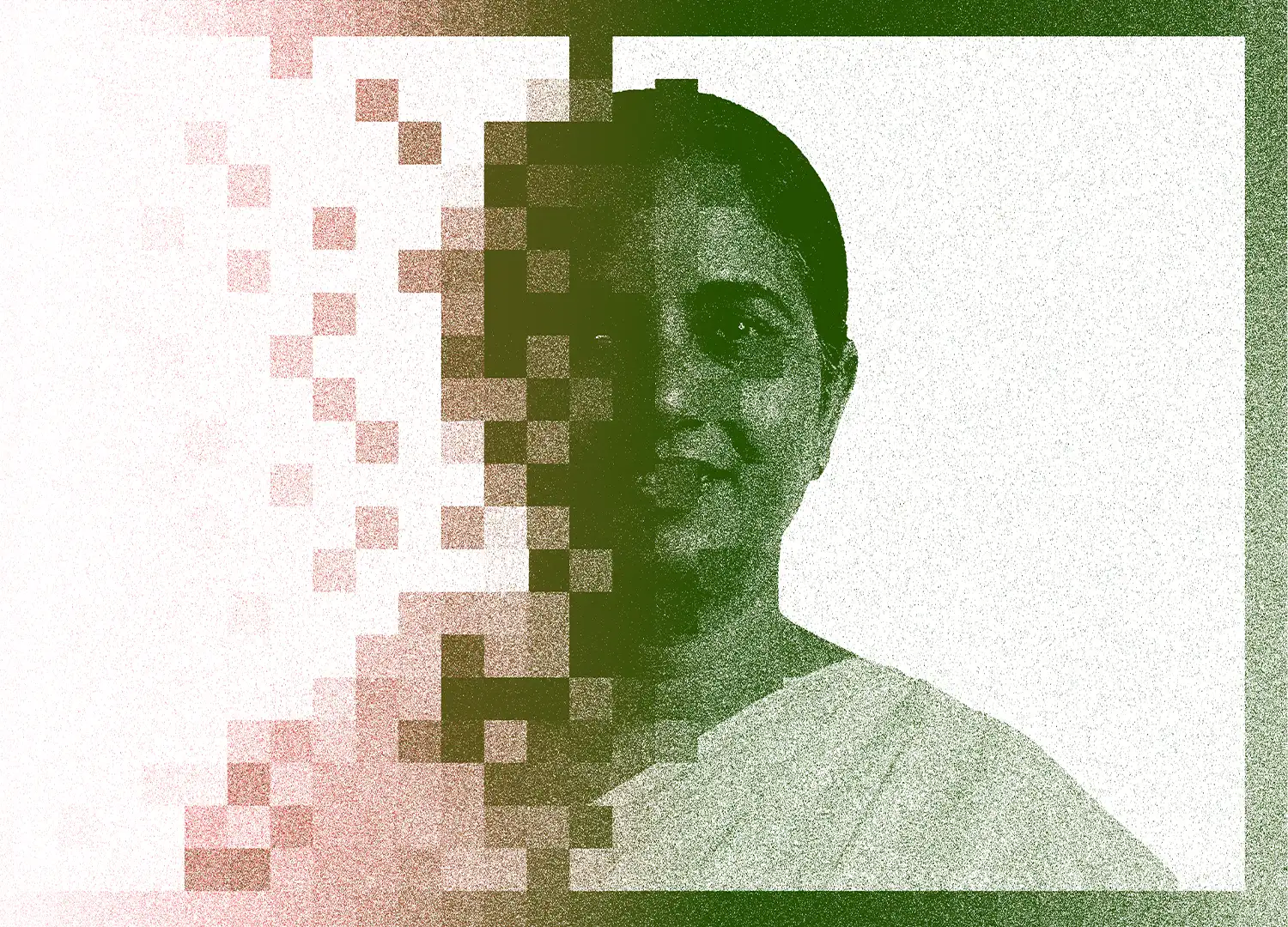
Facebook pages connected to Jamaat-e-Islami shared and promoted through paid advertising dozens of images that appear to show real individuals, identified by name and profession, but who are unlikely to exist.
Social media accounts linked to the party have published more than two dozen photographs of purported voters as part of campaign materials. However, experts consulted by Netra News said the people depicted in the images were likely not real and were probably created using artificial intelligence. The practice may breach Election Commission rules restricting the use of AI-generated content in election campaigns.
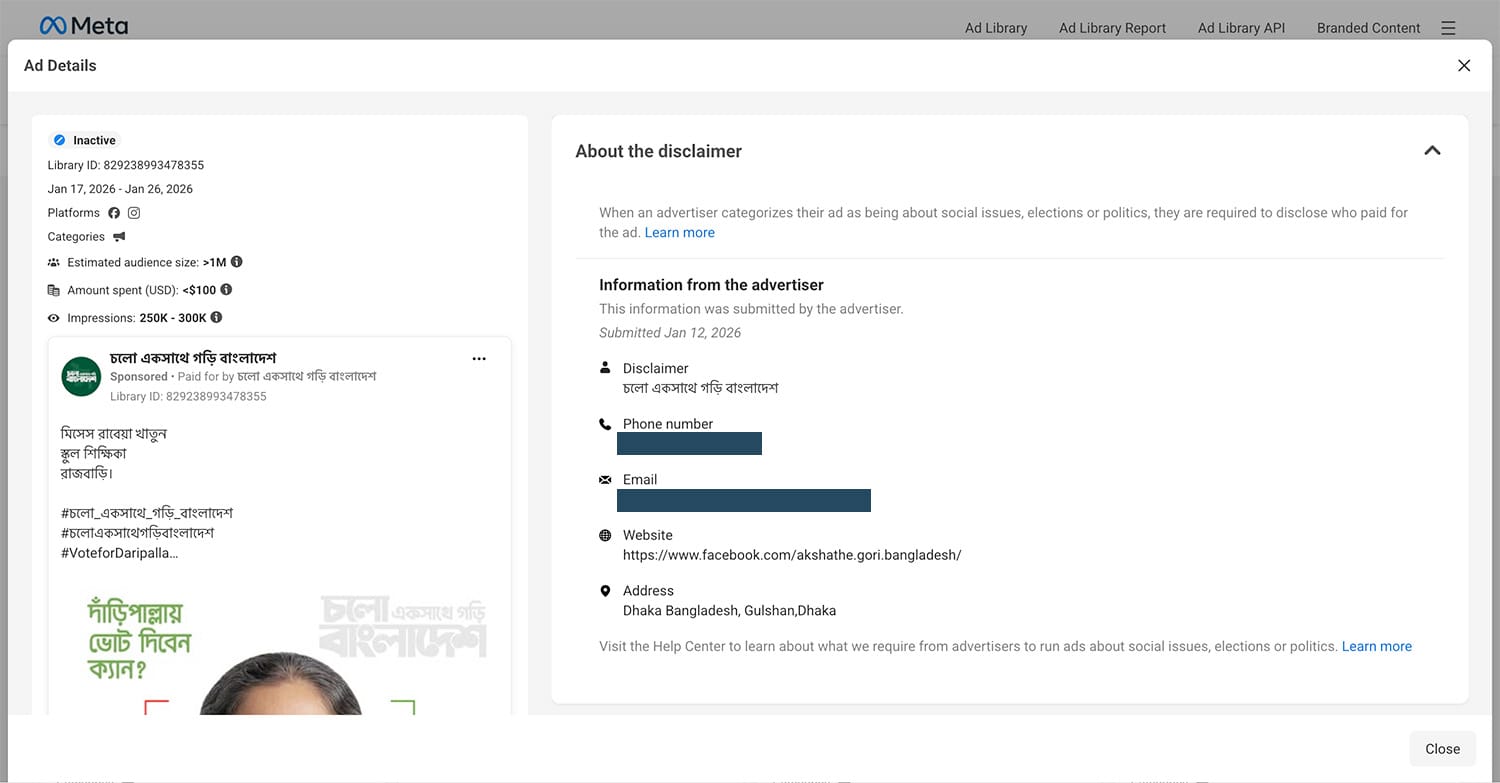
Facebook pages — including “চলো একসাথে গড়ি বাংলাদেশ” (Let’s Build Bangladesh Together) and “Our Leader – আমাদের নেতা” — with a combined following of half a million users, published portraits of individuals presented as real people, identified by name and profession.
In one post published on January 17th 2025, a portrait of a woman identified as “Mrs Rabeya Khatun, school teacher” was featured. Text overlaid on the image read: “Why would you vote for Daripalla (scale of balance)?”, referring to Jamaat-e-Islami’s electoral symbol. Another line provided the answer: “their boys don’t disturb my daughter.”
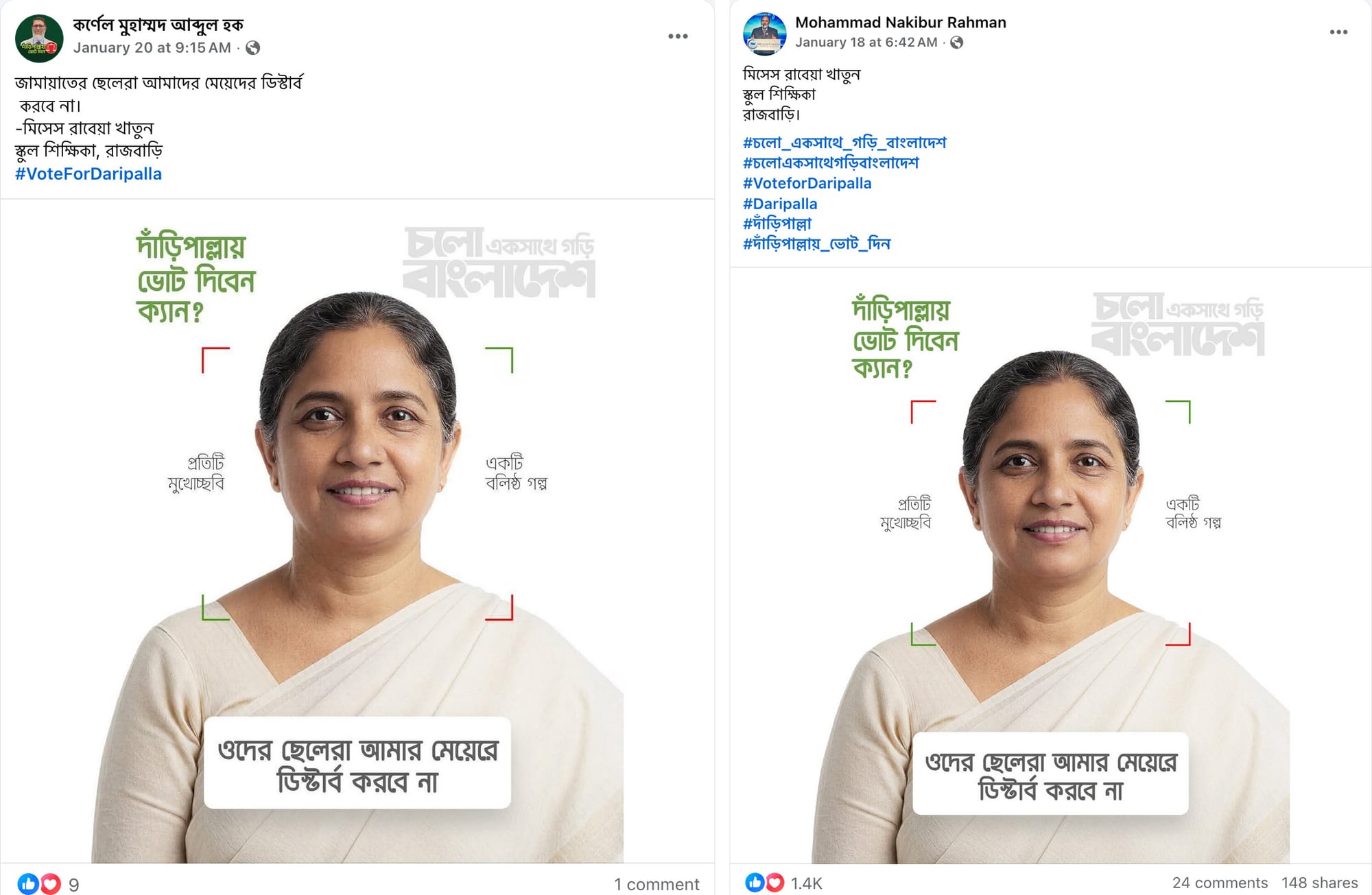
The same photo was separately posted by several Jamaat parliamentary candidates, including Colonel (Retd) Mohammad Abdul Haq, and Mohammad Nakibur Rahman, who describes himself as the party’s international spokesperson.
Google’s AI-detection tool, which analyses content generated using its Gemini service, identified residues of AI use in at least eight of the images, including the one featuring “Mrs Rabeya Khatun, school teacher”. Netra News also submitted several of the images to WITNESS, a New York-based human rights organisation specialising in video and image analysis. Four separate teams at WITNESS, including its Deepfake Rapid Response Force, assessed the content and categorised it as “Very Likely GenAI”.
“Four teams have analysed the images. Three of the teams found strong evidence of AI manipulation. While one team received inconsistent results across different images, the assessments of the other three teams are strong enough to conclude that the images were likely generated or manipulated using AI,” said Zuzanna Wojciak, a researcher on technology threats at WITNESS, in a statement summarising the findings.
Netra News contacted Belal Hossain Ethun, whose account is listed as the advertiser for both pages in Facebook’s Ad Disclaimer database. Reached via a listed phone number, he denied that AI had been used to generate or modify the photos. After initially promising to connect this reporter with his clients, he stopped responding and blocked the reporter’s number on WhatsApp. “None of the photos are AI generated. We have graphic designers,” he said before cutting off contact.
Netra News found indications that the individuals behind them operate in coordination with the party.
From Belal Hossain Ethun’s Facebook profile, Netra News obtained a photograph showing him at an event wearing an organiser’s identification card and carrying a camera. The event was titled “Hello Our Leader | Ameer-e-Jamaat Meets Gen Z.”
Another image from his Facebook page, titled “Ethun’s Earth” shows him wearing an ID card for Jamaat’s “Policy Summit 2026,” suggesting involvement in organising official Jamaat-e-Islami events.
Netra News also contacted Omar Sharifullah Hassib, a marketing professional who had made collaborative Facebook posts with the “Our Leader – আমাদের নেতা” page and posted what appeared to be footage from inside the campaign vehicle of Shafiqur Rahman, the Jamaat chief.
Hassib declined to say whether any of the materials were AI-generated, citing confidentiality agreements. “If you are desperate to know about these issues, I would rather suggest that you contact Jamaat-e-Islami,” he said in a voice note on WhatsApp. Shafiqur Rahman’s official Facebook page has also shared collaborative video content with the “Our Leader – আমাদের নেতা” page.
Mir Ahmad Bin Quasem, Jamaat’s candidate for Dhaka-14, who also shared some of the images, said he knew the managers associated with the pages but that they declined to comment through him. He said the individuals depicted in the campaign materials were real, but unwilling to be interviewed. Spokespersons for Jamaat’s media wing did not respond to multiple requests for comment.
Several posts follow a similar format to that of “Mrs Rabeya Khatun”, featuring individuals identified as a fruit seller, private university student, industrialist or female university student — each named and described by profession. Each image attributes a statement explaining why the individual would vote for Jamaat-e-Islami.
Two likely AI-generated photos referred to the same individual
After Netra News contacted Belal Hossain Ethun, his phone number and the post featuring the likely fictional Mrs Rabeya Khatun was removed from the “চলো একসাথে গড়ি বাংলাদেশ” page. Similar images remain online.
The page, created on November 20th 2025, has also run paid advertisements featuring these images. In total, it has published 26 advertisements promoting Jamaat-e-Islami.
At least four Jamaat-e-Islami affiliates — with a combined following of more than 243,000 Facebook users — shared several of the posts. Among them, Mawlana Saroar Hossain, the party’s candidate for Faridpur-4, shared one such image, while Mir Ahmad Bin Quasem shared two posts from the page’s white-background portrait series.
When contacted, Bin Quasem initially said, “Let me check if the people approve of me sharing their details.” He later said, “I am afraid they prefer to be anonymous,” citing security concerns. He added that the initiative was run by individuals acting of their own volition, “not the [Jamaat] party’s doing,” even though Omar Sharifullah Hassib, who campaigned with the party’s chief, referred questions about his activities to Jamaat.
If Jamaat-e-Islami as a party was involved in disseminating AI-generated images, it could breach Election Commission campaign rules. As a candidate, sharing AI-generated content could also place Bin Quasem in violation of regulations, which rule that “AI shall not be used dishonestly on election related matters including for campaign purposes.”
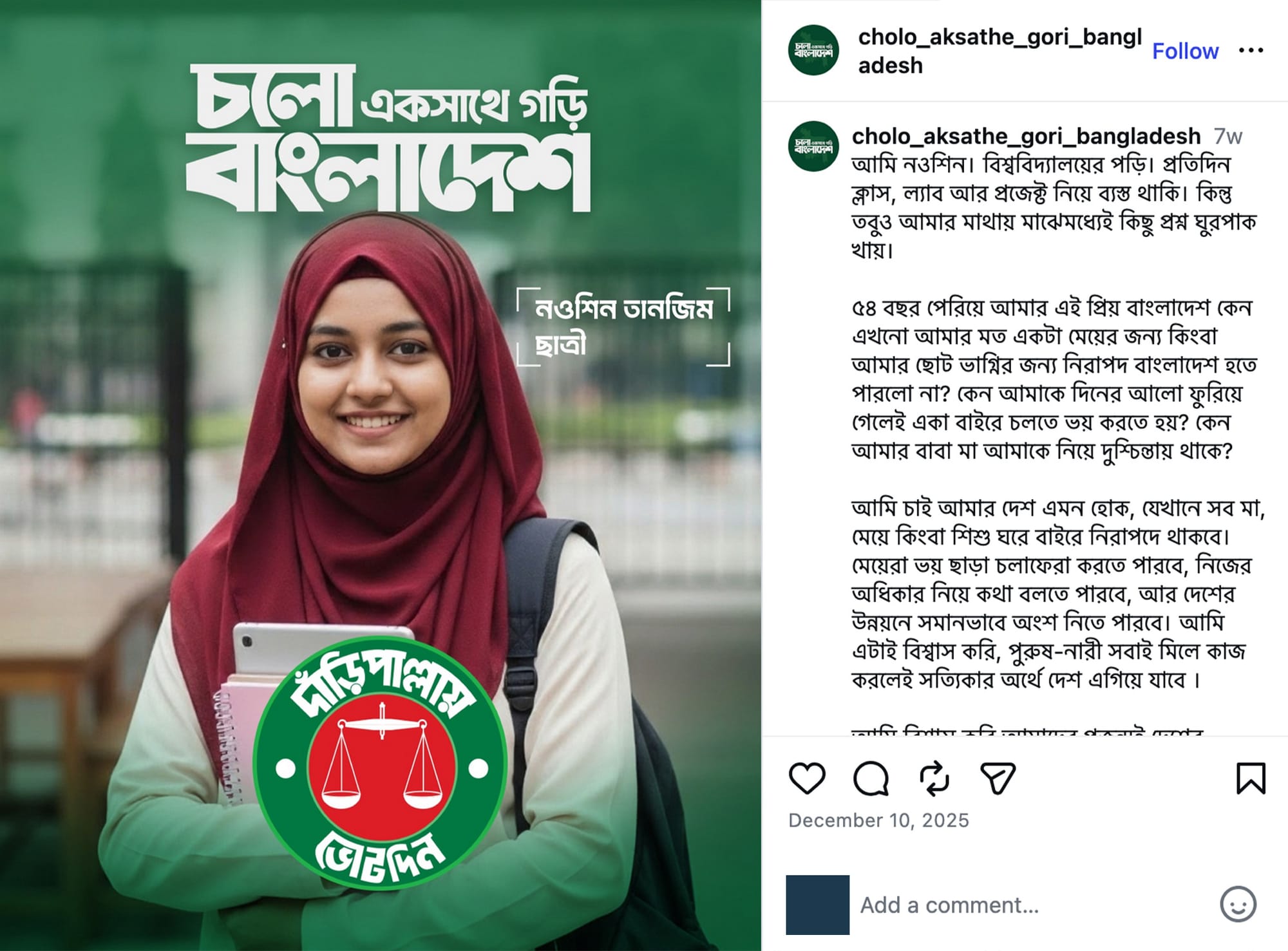
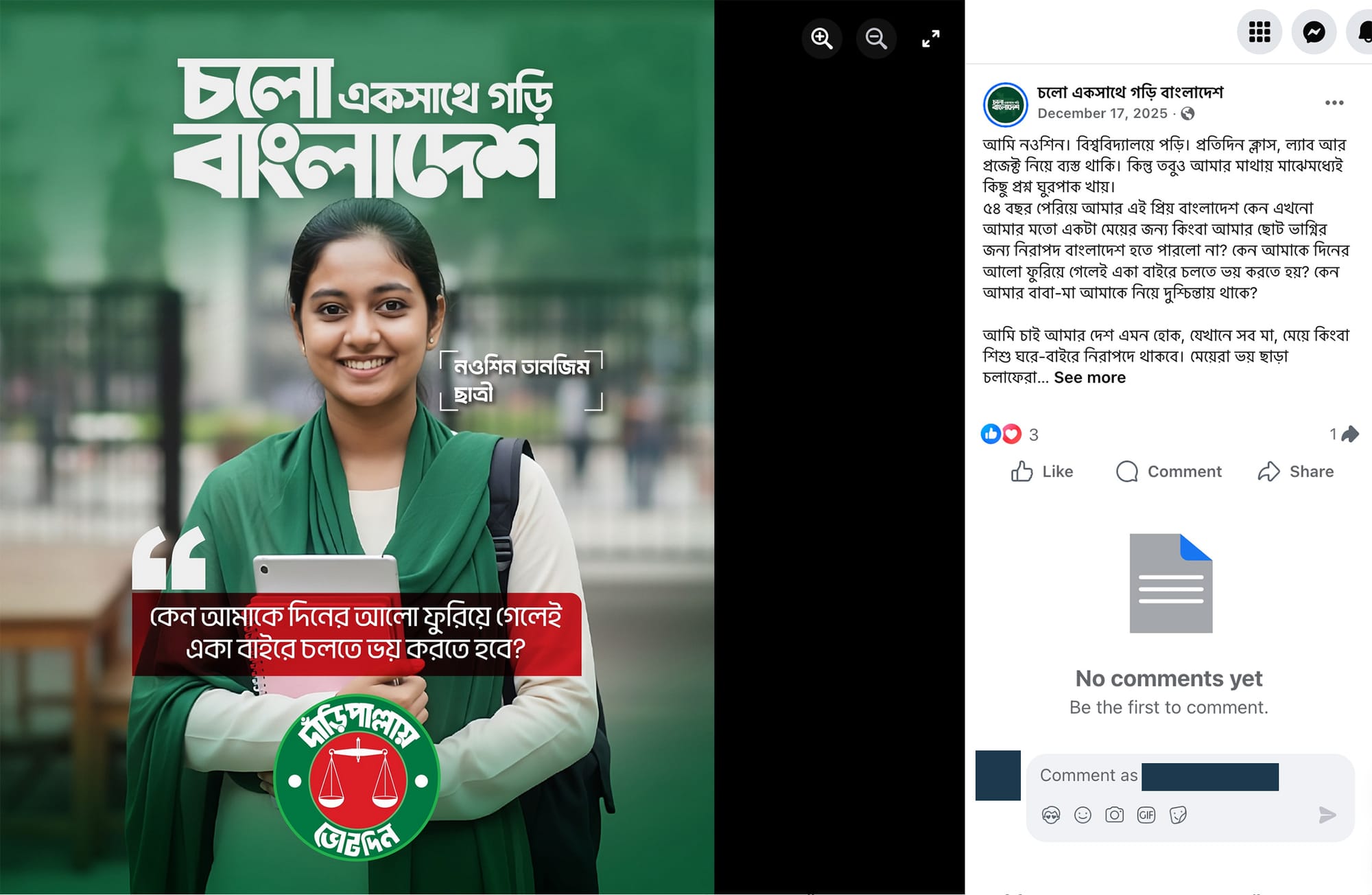
A separate series of images published by the same pages followed a similar format, depicting supposed voters endorsing Jamaat-e-Islami in settings such as streets, bazaars and classrooms. One image showed a girl identified as “নওশিন তানজিম, শিক্ষার্থী,” (Nawshin Tanzim, Student) holding a tablet and notebooks against a blurred classroom background. A similar avatar appears on an Instagram account linked to the page, this time wearing a hijab with slight variations.
“This is inherently misleading, especially during elections, when people are exposed to such a high volume of content that they often do not have the time to verify what is true and what is false,” said Miraj Ahmed Chowdhury, who runs Digitally Right, a Dhaka-based think tank specialising in information integrity.
“And when this kind of material is disseminated in an organised, coordinated manner [including paid ads] ahead of an election, it becomes inauthentic campaigning, which in many cases can influence voters’ decisions — and that is precisely why such campaigns are created,” he said.
With sophisticated AI tools now widely available, such content is spreading at unprecedented scale, making it increasingly difficult for the public to assess authenticity. “What we did observe [in 2024 elections] were a few fake deepfakes circulated in the names of two candidates, falsely claiming they were withdrawing from the race, as well as numerous fabricated photo cards where faces and images were stolen,” Chowdhury said.
“In this election cycle we are seeing AI used across the spectrum — from legitimate information campaigns, music, and entertainment to misinformation, hate speech, and other harmful applications,” he added.
“What we are witnessing this time is unprecedented.”●