On the cricket field, Bangladesh and India’s ‘war minus the shooting’
India bowled a loose delivery. Bangladesh hit it for six. But what comes next matters more.
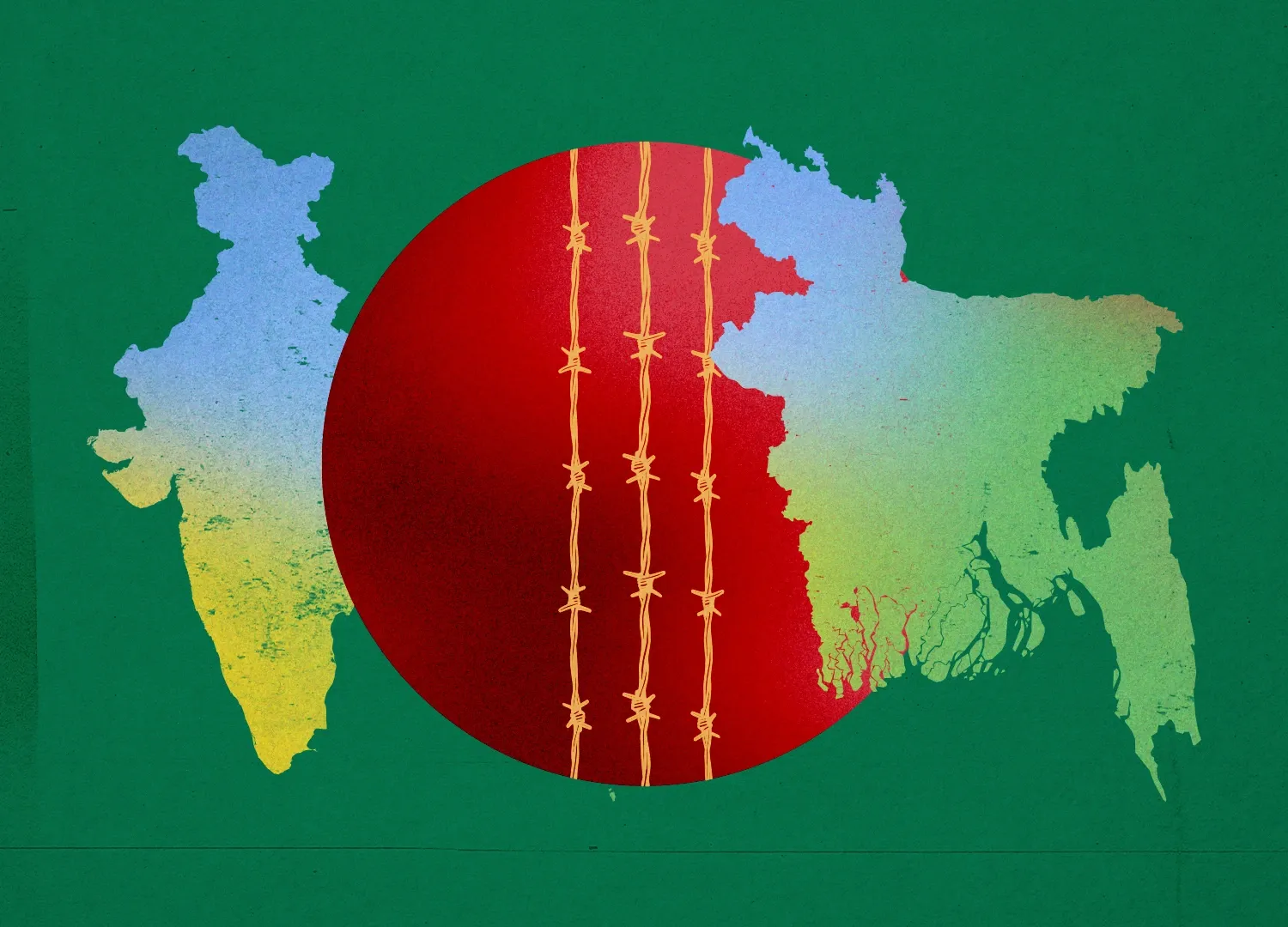
There are many false aphorisms in circulation around the world. But one of them is so untrue that it borders on the ridiculous. It goes like this: don’t mix politics with sport. Those who believe this strange, sanitised idea of “depoliticisation” conveniently forget one basic truth: international sport is politics. Not just politics, some would argue, but the modern substitute for war itself. For thousands of years, nations fought to conquer territory and assert superiority. Today, that same instinct is merely restrained and redirected onto the playing field. The hunter’s urge to annihilate the opponent has not disappeared; it has been domesticated. In an age where outright war is less frequent, states compensate through sport.
That is why George Orwell famously described international sport as “war minus the shooting”. Borrowing that phrase, American sportswriter Mike Marqusee wrote an entire book under the same title, examining how the 1996 Cricket World Cup in the Indian subcontinent was shaped by politics, diplomacy, and power — and how it, in turn, reshaped politics across South Asia and the wider cricketing world.
Exactly thirty years later, on the eve of yet another World Cup in South Asia, cricket diplomacy is once again heating up. This time, the flashpoint is between two neighbours: Bangladesh and India. Like Marqusee once did, we can use this moment to look beyond cricket — at regional power, bilateral relations, and the larger political currents shaping both countries.
The immediate trigger was Bangladeshi cricketer Mustafizur Rahman. Despite being bought by Kolkata Knight Riders (KKR) for over nine crore rupees, the franchise was forced to release him for safety following intervention by the Indian cricket board. The explanation offered was blunt: under the current circumstances, Mustafizur could not be allowed to play. The real reason soon became clear. A senior leader from India’s ruling Hindu nationalist BJP had openly threatened action against KKR if Mustafizur played in the Indian Premier League. He went further, branding KKR’s owner, Bollywood superstar Shah Rukh Khan, a “traitor” and even threatening to expel him from the country.
That detail matters. Shah Rukh Khan, despite being India’s biggest star, is Muslim. So is Mustafizur. Under BJP rule, India has seen people lynched over something as trivial as allegedly storing beef in a fridge, and many Muslims beaten to death on mere suspicion of being Bangladeshi. Non-Hindus live under constant insecurity. A toxic mix of communal hatred and vigilante violence has become routine.
Yet the same BJP now claims that, following the fall of Sheikh Hasina’s long authoritarian rule in 2024, Bangladesh has become a site of systematic persecution of Hindus. Indian media outlets have gone into overdrive, spreading outright misinformation and alleging genocide. Much like Pakistan, Bangladesh is being cast as a hostile “other”, a convenient external enemy to fuel domestic Hindu nationalist sentiment.
It would be dishonest to deny that Bangladesh has been unstable for the past year and a half. An ineffectual interim government has failed to prevent mob attacks, including the destruction of shrines. Some non-Muslims have indeed been targeted due to political vendettas or property disputes. But this is not remotely comparable to the state-sponsored, industrial-scale production of communal hatred seen in India today.
Still, the BJP government — which itself shelters the deposed autocrat Sheikh Hasina — appears determined to inflame tensions. Visas for Bangladeshis were tightened immediately after her fall. Diplomatic engagement has cooled. Under Modi, India’s relations with almost every South Asian neighbour — bar the Taliban — have deteriorated. In cricket too, India behaves like an unchallenged hegemon. As the biggest financial contributor to the sport, it acts with impunity. That mix of money, arrogance, and aggressive diplomacy now dictates the politics of global cricket.
The Mustafizur episode fits squarely into this pattern. What India failed to anticipate was retaliation. For Bangladesh, this incident came just weeks before India is due to host the T20 World Cup. Dhaka asked a simple, devastating question: if India cannot guarantee the safety of one Bangladeshi cricketer, how can it ensure the security of an entire team — not to mention journalists and thousands of travelling fans? Bangladesh pointed out that special arrangements had once been made for Pakistan in Sri Lanka. Either the same guarantees would apply — or Bangladesh would not play.
Such standoffs are not unprecedented. Australia and the West Indies refused to play in Sri Lanka in 1996. England skipped Zimbabwe in 2003; New Zealand avoided Kenya. Zimbabwe withdrew from the 2009 T20 World Cup. Australia refused to send its Under-19 team to Bangladesh in 2016 — even though its football team had visited shortly before. The contrast revealed the difference between FIFA and the ICC: corrupt as FIFA may be, it can still take firm positions. The ICC, by contrast, is largely spineless. Its “big three” model consistently privileges India, England, and Australia. Pakistan is shunted into absurd hybrid tournaments at India’s insistence and it was still forced to play the 2023 World Cup in India.
What makes this time different is that the Indian government visibly folded before extremist threats. In the early 1990s, Shiv Sena goons vandalised pitches ahead of Pakistan tours. India itself has received threats abroad. Such noise is not new. What is new is the state’s willingness to concede. That sends a dangerous signal — and leaves Bangladesh no room to take risks.
India likely assumed Bangladesh would never boycott a World Cup. Had it foreseen this response, the Mustafizur issue might have been deferred until after the tournament. The IPL, after all, begins later. But politics is rarely that simple. Assembly elections are approaching in West Bengal. For the BJP, long absent from power there, anti-Bangladesh rhetoric combined with cricket and religion is an irresistible electoral weapon.
Would there have been such outrage had Mustafizur played for a franchise outside Kolkata? Hard to say. Politics thrives on precision and timing. In today’s post-truth age, teaching people to hate like zombies is often enough to win elections — as Modi and Trump have both demonstrated.
Ironically, not long ago, India’s foreign minister attended Khaleda Zia’s funeral in Dhaka and met her son Tarique Rahman, now BNP chief. The visit suggested India wants to normalise ties — but only with a future government, bypassing the interim one. Perhaps that is pragmatically sound. Yet Bangladesh carries deep resentment and justified suspicion: India sought to install compliant governments. Hasina’s rule embodied that dynamic. By sheltering her after her overthrow, India repaid loyalty.
So any Bangladeshi government must tread carefully. For a small country, living next to a large, aggressive neighbour is a perpetual struggle.
Still, populist rhetoric in Dhaka cannot substitute for policy. “Delhi or Dhaka?” slogans stir emotion, but they do not build economic independence or reduce structural dependency on India. There is no visible roadmap for investment, industrial revival, or a balanced foreign policy. Economist Maha Mirza recently summed it up sharply: resisting unjust arrangements — from border killings to Adani’s energy dominance, from Teesta water sharing to transit deals — requires economic self-reliance and long-term strategy. Shouting slogans with a broken economic backbone does not stop hegemony.
Back to cricket diplomacy. A good cricketer, like a good diplomat, knows the target and plans accordingly. Swinging wildly at every loose ball does not make you a great batter. India bowled a loose delivery. Bangladesh hit it for six. What comes next matters more.
Bangladesh has shown that Indian bullying can be confronted. Local reports in Bangladesh suggest India even considered reinstating Mustafizur in the IPL. The Bangladeshi cricket board initially pursued procedural routes — asking about security protocols, considering sending its own security team. That alone would have deeply embarrassed the host. Before it came to that, the Bangladeshi government escalated matters.
For an interim administration struggling with legitimacy, law and order, and mob violence, anti-India posturing is the easiest political card. With only weeks left in office, it has little incentive to worry about long-term diplomatic fallout.
But strategy demands clarity. What is Bangladesh’s endgame with India? Total rupture? Permanent hostility? That would hurt ordinary people on both sides and benefit only extremists. The smarter path is negotiation — extracting respect, equality, and fair terms.
This was an opportunity to bargain: more tours, better revenue shares at the ICC, leverage through alliances. Cricket diplomacy works in blocs. India alienating both Pakistan and Bangladesh is not in its long-term interest — regardless of BJP’s short-term gains.
In 1996, when non-Asian teams boycotted Sri Lanka, a joint squad led by Azharuddin and Imran Khan toured Colombo in solidarity. That gesture demonstrated Asian unity — a force that later helped Bangladesh and Afghanistan gain Test status. Without political blocs, teams like Kenya faded despite past success, while Ireland and Scotland stagnated. Power, not just talent, shapes cricket’s hierarchy.
Both Bangladesh and India must recognise this. Bangladesh, in particular, should link cricket diplomacy with broader demands — Teesta water, Farakka, border killings — and push for genuine regional cooperation, including reviving SAARC.
Diplomacy is a cool-headed craft. Bangladesh is the small fish in a big pond. Survival requires skill, unity, and realism. Unfortunately, BJP ideologues on one side and hate-mongers on the other prefer perpetual tension. Religion and identity make for easy mobilisation.
Bangladesh stands at a crossroads. People are desperate to escape decades of one-sided subservience. No weak stance will be tolerated. Skipping a World Cup may not hurt Bangladesh materially; it may even offer moral strength. But every move must anticipate the next.
Does Bangladesh want war with India? A complete rupture? That would only empower warmongers. What is needed instead is diplomacy grounded in equality and dignity.
Bangladesh must also fix its own cricket — not as an overhyped nationalist prop, but as a genuinely competitive force drawing strength from a 200-million-strong market. The question remains: can the resolve shown in the Mustafizur episode translate into economic strategy and foreign policy?
Rudyard Kipling once asked, “What should they know of England who only England know?” C. L. R. James later echoed: “What do they know of cricket who only cricket know?” Cricket is not just runs and averages. It is empire, race, class, and power.
Cricket is a deeply political and diplomatic instrument. Bangladesh’s cricketing achievements may be modest and largely politically enabled. Yet therein lies the paradox: even an inflated balloon of nationalism can become a vehicle for real change. The fight for justice, dignity, and equality — for Bangladesh — might just begin on a cricket field.●
Syed Faiz Ahmed is a writer, translator and columnist. The original piece was written in Bengali.