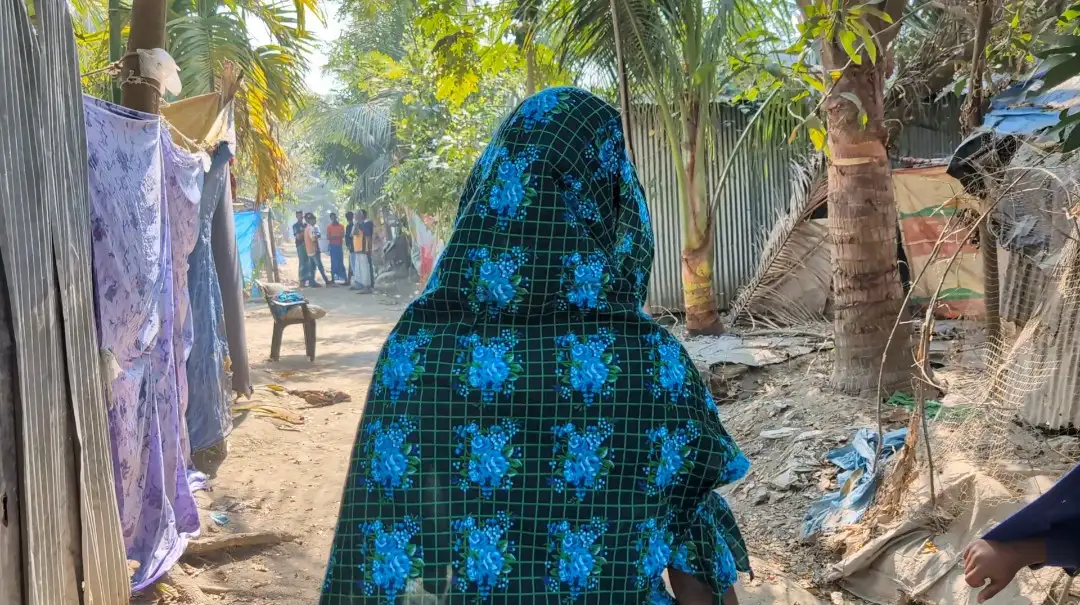
In Hatiya, women say their votes brought violent retaliation
One woman says she was raped. Officials have yet to release key forensic findings.

On February 12th, election day in Bangladesh, thousands of women in Hatiya — a windswept island in the southeastern district of Noakhali — went to the polls. Among them was a mother of three who walked to a polling station in Chandoni union, where she cast her vote for the National Citizen Party, also known as NCP.
The following day, she said, that choice brought trouble to her doorstep.
“My husband and I were inside the house,” she said in a recent interview. “Rahman started kicking the door, shouting, ‘Open up! You supported the NCP, you campaigned for them’.”
She was referring to Abdur Rahman, an activist affiliated with the Bangladesh Nationalist Party (BNP)’s youth wing in Hatiya. The woman said he was among a group of men who came to her house. The men, she added, forced their way inside in front of her three children. They tied her husband’s hands and feet and locked him in a room.
“Then Rahman raped me while others stood guard,” she recalled.
“It was because of the vote,” she added. “The conflict was all about the election. They wanted the Dhaner Sheesh” — the sheaf of paddy, the symbol of the BNP — “but I voted and became an agent for the Shapla Koli,” the waterlily bud of the NCP.
Rahman denied the allegation, telling Netra News that it was a conspiracy. “I don’t know the person [alleging rape] and don't have anything to do with her,” he said, even as he acknowledged visiting his stepmother, who lives near the woman he is accused of raping. “It’s a conspiracy against me,” he added. In other media interviews, he said he had been physically assaulted by NCP supporters. That he sought treatment for an injury after a scuffle was supported by hospital surveillance footage.
Nonetheless, that allegation has cast a shadow over an election that officials and many observers described as largely peaceful. The BNP went on to win the election handsomely, but the claim spread widely on social media, in part amplified by NCP leaders with millions of followers, with many users drawing parallels to past instances in which women were raped for casting ballots of their own choosing.
Six days after the vote, reporters from Netra News travelled to the village to meet the woman at her home — a frail, half-brick structure provided under the government’s Ashrayan Project, a housing programme for landless families. She lives there with her husband, himself a day labourer, and three children.
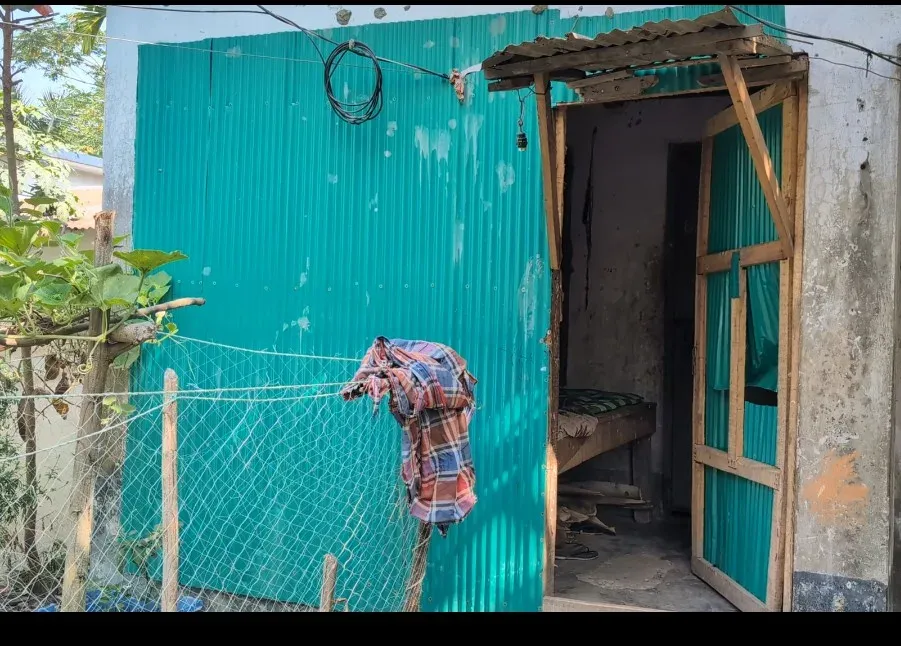
On February 13th, the day after ballots were counted in the Chandoni union, the Shapla Koli symbol became, residents said, a target on women voters’ backs. The tensions followed the victory of Abdul Hannan Masud, a 26-year-old recent graduate of Dhaka University, who won the Noakhali-6 constituency — which includes Hatiya — becoming Parliament’s youngest member.
‘Paralysed by fear’
Saiful Islam, a local resident who said he witnessed the violence, described what he called a coordinated campaign of intimidation that unfolded on that evening. “The retaliation targeted anyone associated with the symbol. Voters, grassroots activists, polling agents — no one was spared. Their homes weren’t just attacked; they were looted.” But he said another assault occurred around 11:30 p.m. “It was during this time that the victim was raped,” Islam added. “Eight women were assaulted, and the meager belongings of ten families were looted.”
“They came with sticks and iron rods in every hand,” Runa Akter, a neighbour of the woman, recalled the attack that night. They shouted, she said, ‘Why did the women support the NCP? Why did they vote for the Shapla Koli instead of the Dhaner Sheesh?’
At least ten local residents, women included, told Netra News the men verbally and physically abused women voters. “We bolted our doors, paralysed by fear,” recalled Parveen Begum, another neighbour.
‘Gross insult’
The Netra News investigation suggests that authorities may have mishandled the rape case.
The Hatiya police station lies across the Meghna River from the Ashrayan settlement. According to the woman and local residents, police did not contact her despite the nationwide outcry.
Dr. Mostafizur Rahman, an attending physician at Noakhali Sadar hospital where the woman went seeking treatment, told Netra News that a medical report would be issued following a preliminary forensic examination. A DNA test was later conducted on February 19th.
But as of the time of publication, no medical report had been released. A forensic specialist consulted by Netra News said that the collection, testing, and reporting of rape-related evidence typically takes no more than five days. Tahmina Akter, a doctor on the medical inquiry board, said she knew nothing about the report’s progress and that it would be sent directly to the court once completed.
But even before any examination was carried out, the island’s top police officer had already made up his mind. Three days after the rape allegation surfaced publicly, Md. Nurul Anwar, a senior police officer in Hatiya, dismissed the allegation as “propaganda” in a conversation with a reporter. He claimed no rape had occurred even though no formal investigation had yet been launched.
He also suggested the incident might stem from a property dispute, even as the woman’s family lives in a government housing project for landless people. Speaking to Netra News, Abdur Rahman — the accused — also contradicted the police official’s statement. He said he had no prior dispute with the woman or her family.
Abu Ahmed Fayzul Kabir, a coordinator at the legal aid and human rights organisation Ain o Salish Kendra, criticised the police response, calling it as malicious and insulting. “It is deeply regrettable that members of the administration are questioning whether a sexual assault occurred before any evidence has been gathered,” he said. “Making these baseless assertions is not only a gross insult to the victim but also reflects a clear bias against her.”
On February 18th, the woman filed a complaint with a local court in Noakhali specialising in cases of violence against women and children. She named five other men besides Rahman. Four of them live in the same government housing project as the woman. The local police chief, Md Kabir Hossain, told Netra News on March 17th that those named are absconding and could not be questioned. “The case is still under investigation. The victim is undergoing medical examinations. Further decisions will be made once the reports are received,” he said.
Fearing further violence, the woman said, she and her family have since left their home.
“The fear I felt before has only intensified,” she said. “I am now deeply concerned for the safety of my husband and children.”
“Is there no justice for this?”
Runa Akter, her neighbour, says she was terrified as well.
“We have daughters who are growing up; if these atrocities continue, the country will descend into further chaos. We demand a fair investigation,” she added.
“If one incident happens tomorrow and another the day after, it will embolden them to think they are above the law. That is exactly what they are aiming for.”
Netra News reached out to five officials within the BNP and the government by phone and email, but received no response.●
(The story was updated in the seventh paragraph to reflect that Rahman sought treatment for an injury after a clash.)