Election engineered? Independently collected tally sheets suggest otherwise
A review of nearly 1,000 polling-station tally sheets, collected independently from across the country, found only four minor discrepancies with the Election Commission’s published figures


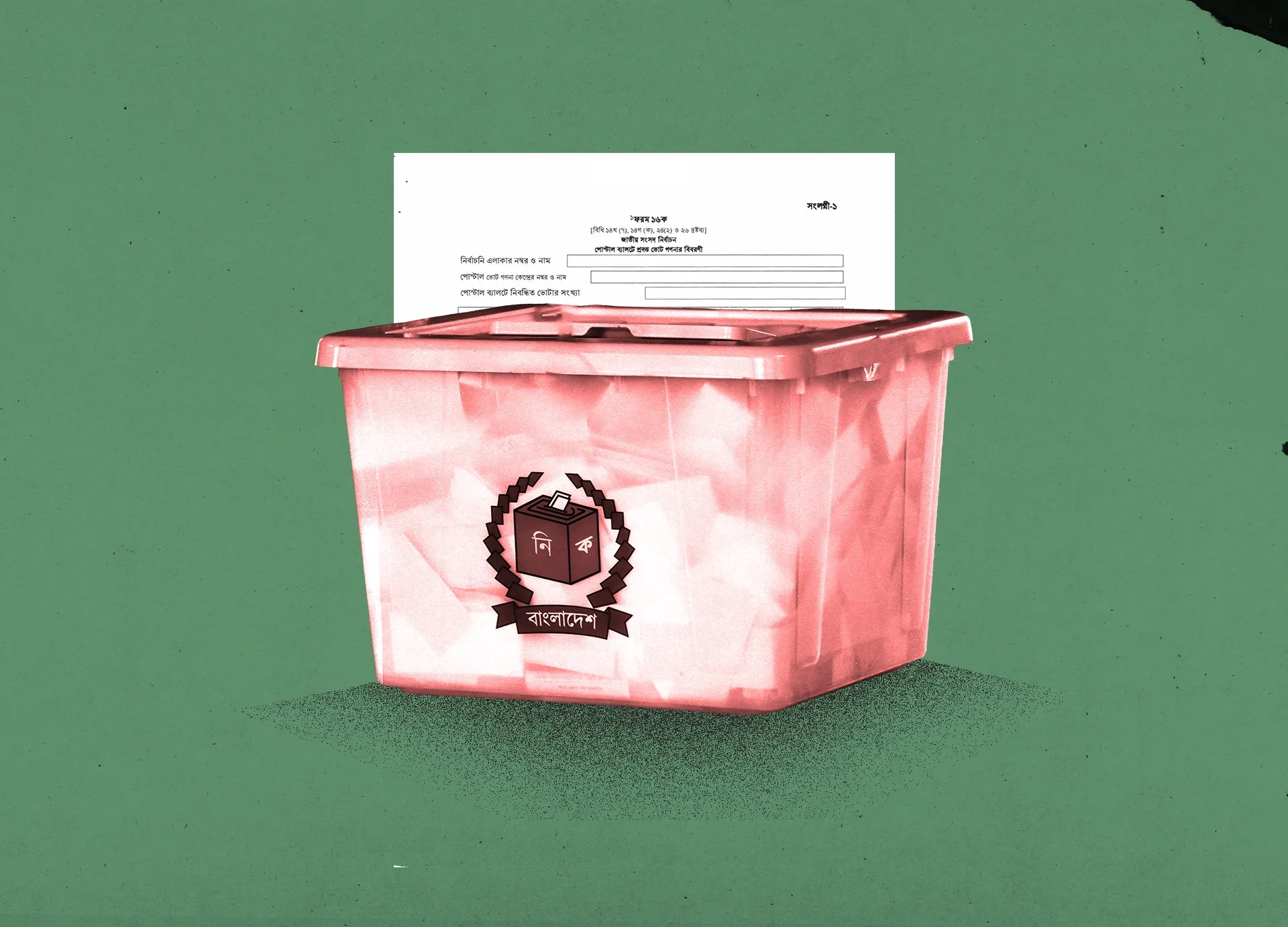
A comparison of election tally sheets collected independently by Netra News with the official figures published by Bangladesh Election Commission has found almost no discrepancies, undercutting a central claim made by several candidates who lost seats in the country’s 12th February parliamentary election.
Jamaat-e-Islami, which did far worse at the ballot than it had anticipated, has described its defeat as the product of “extraordinary engineering.” The party’s secretary general, Mia Golam Parwar, did not dispute that the vote itself was peaceful and credible — a shift from previous cycles when losing parties typically objected to the conduct of polling itself. Because the polls were orderly, Parwar argued, Jamaat’s representatives around the country had been reporting back a decisive victory. Whatever manipulation occurred, he said, happened somewhere “between the counting of the votes and the declaration of results.”
Several candidates with the Bangladesh Nationalist Party (BNP) offered a similar theory. Mohammed Kaiyum, who stood in Dhaka against the National Citizen Party’s president, Nahid Islam, invoked “engineering” at a press conference moments after the outcome was declared. Islam himself, who does not make the claim about his own seat, nonetheless blamed the same mechanism for his alliance’s wider defeat.
The framing marks a shift.
Losing parties in Bangladesh have long refused to accept unfavourable outcomes — a defining feature of the country’s political culture — but in past cycles, particularly under the Awami League, the grievance centred on overt rigging: intimidation, captured booths, stuffed ballots. This time, the parties concede the polls themselves were orderly. The allegation is that the figures were altered afterwards, through a process they refer to, without further explanation, as “election engineering.”
How Netra News tested the claim
Anticipating precisely this line of argument, Netra News deployed hundreds of correspondents across Bangladesh in the months before the vote. On election night and in the hours that followed, a different group of reviewers set about collecting photographs of Form-16 — the polling-station-level tally sheet that records each candidate’s votes at a given centre.
Three types of copies of Form-16 are produced at every polling station. One is handed to the agents of the candidates; one is pasted outside the station for public inspection; and the third travels to the returning officer of the district, who consolidates the figures and transmits them to the Election Commission. Bangladesh has roughly 43,000 polling stations spread across 300 constituencies.
By the morning after the vote, Netra News had 8,000 Form-16s in hand, obtained from candidates, their agents and polling station officials. By the time the Election Commission published its own forms in March, that number had grown to more than 18,000, covering 205 of the 300 constituencies across 48 districts. (For logistical reasons, no sheets were collected from Mymensingh division.)
From that pool, a randomised sample of 1,000 forms was drawn, weighted to reflect the composition of the full 18,000. Each was then compared, line by line, against the corresponding form published by the commission.
Asif Shahan, a professor at the University of Dhaka who reviewed the methodology, described it as “scientifically sound.”
What the comparison found
Forty-three of the sampled forms were excluded — some contained referendum or postal ballots, others a different official form, and a handful were too unclear to read.
Of the 957 sheets that remained, only four showed any discrepancy at all. All were minor.
- In Brahmanbaria-6, Habibur Rahman of Insaniat Biplob was credited by the Election Commission with 19 votes at Bhurbhuria Government Primary School centre; the Form-16 collected by Netra News recorded one.
- In Feni-2, Jasim Uddin of the Socialist Party of Bangladesh (Marxist) appeared with one vote at Ruhitia Primary School centre on the sheet obtained by Netra News, but none on the commission’s.
- In Chandpur-4, Maqbul Hossain of Islami Andolon Bangladesh was shown with 62 votes on the commission’s tally at Protyashi Primary School centre, and 64 on the copy obtained by Netra News.
- The largest gap appeared at Badarpur Mahabidyalay centre in Bhola-3, where Hafiz Uddin Ahmed, Bir Bikram — a veteran BNP leader and the current speaker of parliament — was credited by the commission with 1,129 votes, against the 1,229 shown on the Form-16 obtained by Netra News, a difference of 100.
What the forms looked like
Every Form-16 reviewed bore the signature of the centre’s presiding officer and an official seal. In some instances, the section reserved for the signatures of polling agents — the candidates’ representatives — had been left blank.
Dr Md Abdul Alim, an electoral specialist and a member of the Electoral Reform Commission set up by the interim government, said that was not in itself unusual. “If the result sheets do not have the signatures of the polling agents, that’s not sufficient for one to claim that there were indeed irregularities,” he said. The more revealing test, he added, was the comparison Netra News had carried out: “If the results from the polling centre and those prepared by the presiding officer do not match the results declared by the electoral commission, we can speculate that there may be some irregularities.”
What the review cannot show
The exercise has clear limits.
It cannot detect whether voters were intimidated at the gate, whether ballots were stuffed before counting, or whether intentional manipulation or errors crept into the vote count itself at individual stations.
What it can detect is tampering after the count — in the journey from the polling station to the election commission — and on that question, in the sample examined, the evidence points in one direction: the numbers, overwhelmingly, match.●
Faria Fatima Sneho, Al Amin Tusher, Prantosh Boidya, Subinoy Mustofi Eron, Mizanur Rahman, Iffat Ara Munia, Zabi Hullah, Ankan Ray and Mofizur Rahman contributed reporting.